Three Nights at a Victorian Cottage in Oregon Illinois
Item Number: 252
Time Left: CLOSED
Description
There really is an Oregon in Illinois!!!!!
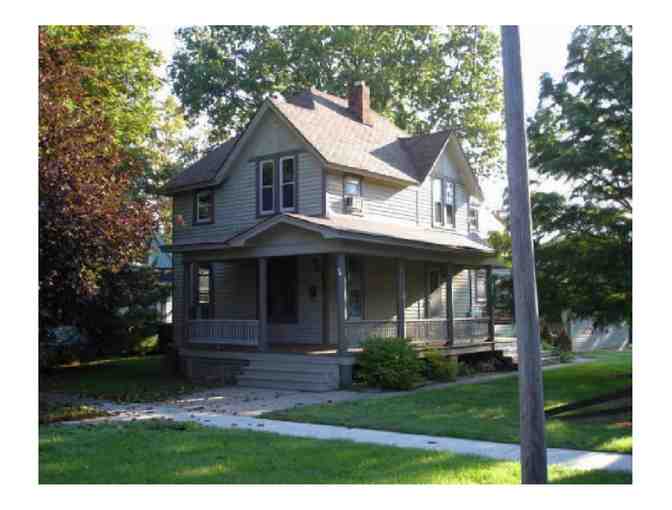
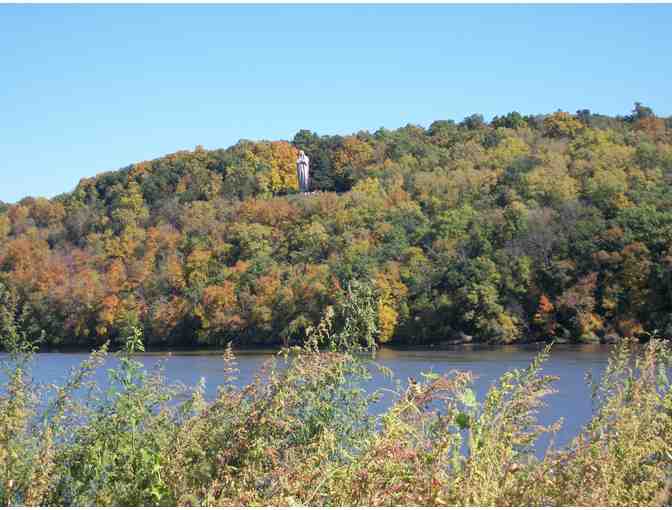
Weary of big city hassles? Want to just get away from the hustle bustle for a couple of days? Then plan a sojourn to an 1871 Victorian country cottage in Oregon in northwest Illinois, Ogle County’s seat just two hours from Chicago’s north side. Conveniences and amenities abound in this two-story, three bedroom retreat situated a few blocks from the scenic Rock River and four state parks – Castle Rock, White Pines, Lowden and Lowden-Miller. Outdoor activities include hiking, kayaking, fishing, horseback riding, picnicking and more. Cottage is a five minute drive away from the iconic Blackhawk Statue - a great piece of history, a great view, and over 200 steps down to the riverside trails at the bottom (pictured above).
Cottage sleeps six comfortably and is available two to three days, weekdays or weekends.
ABOUT: The land Oregon, Illinois was founded on was previously held by the Potawatomi and Winnebago Indian tribes. In fact, later, settlers discovered that the area contained a large number of Indian mounds, most 10 to 12 feet in diameter. The name Oregon means "River of the West".
The first European to visit the land was pioneer John Phelps. Phelps first visited the area in 1829 and returned in 1833 hoping to find a suitable site to settle. Phelps found a forest and river-fed valley which impressed him enough that he built his cabin there. Other pioneers followed Phelps to this site, and Phelps helped create the first church, school, grocery store, blacksmith shop, and post office in Oregon. By December 4, 1838, due in large part to the efforts of Phelps and his brothers B.T. Phelps and G.W. Phelps, the land was claimed, subdivided and certified by the Ogle County clerk as Oregon City.
In 1839 Oregon City was renamed Florence after a visitor compared the scenic beauty of the Rock River to the Italian city of the same name. Florence was used for only about three years when the city opted to revert to its original name, sans the word "city," in 1843. By 1847 the town had a general store, sawmill, ferry, 44 households and a population of 225. The population continued to grow through the 1850s and 1860s, a fact demonstrating by the increasing number of churches in those decades and the building of a railroad in 1871. Industry followed the railroad and Oregon became home to an oatmeal mill, furniture factory, chair factory, flour mill and a foundry, Paragon Foundry, which operated until the 1960s.
The city of Oregon was first organized under an act of the Illinois General Assembly which was approved on April 1, 1869. By the 1870s the town of Oregon and nearby area was home to around 2,000 people. James Gale was elected the city's first mayor on March 21, 1870 and four other men, Christian Lehman, W.W. Bennett, George M. Dwight and George P. Jacobs, were chosen as aldermen. On March 29, 1873 the city was reorganized because of an act of the Illinois legislature which allowed municipalities to incorporate as cities and villages. In 1920 the Oregon City Hall was constructed on the perimeter of the city's commercial district and it has been the center of city government ever since.
The Ogle County Courthouse was built in 1891 on the corner of Washington Street and Fourth Street (Illinois Route 64 and Illinois Route 2). Sculptor Lorado Taft designed and erected a 50-foot-tall (15 m) statue on a bluff overlooking the Rock River valley just north of the city. Originally named The Eternal Indian, it is now known as the "Black Hawk" Statue after the chief of the Sauk Indian tribe that once inhabited the area.
Special Instructions
Available late spring and thereafter
Date must be mutually agreed upon by donor and winning bidder.
IMPORTANT MESSAGE:
Raven will EMAIL this item directly to the winning bidder. There is no pick-up requirement for this item. Items will be emailed within a week of the auction close.
Any questions, please email Jackie@raventheatre.com